Recently, I made the mistake of making a moderation list on Bluesky. Here are some lessons I learned from it.
Background.
#resist is a particularly annoying sub-group on Bluesky (and other social media services). They serve as the politically addicted counter-point to MAGA (leading some people to coin them Blue MAGA).
Life is politics, but these people spend most of their social media existence focusing on politics, and come up with inane schemes on how to subterfuge his campaign.
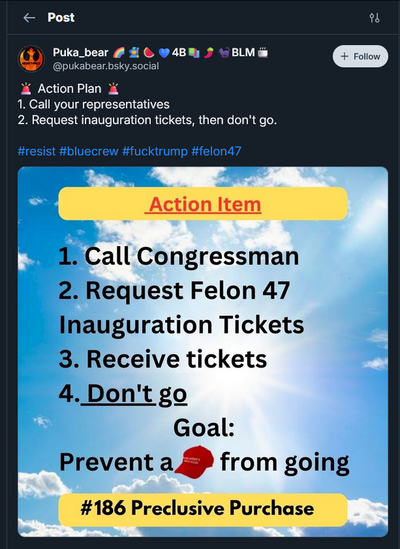
A resistor post
This, I found to be a particularly indicative post. It is a form of protest that achieves very little, and contributes very little to anyone's life. Saying "felon47" is not a particularly useful way of navigating the current political reality.
My choice was to group these people, and mute them en masse.
(It should be noted that moderation lists are not block lists, although they can be used as such. The majority of my subscriptions to these lists are to mute, which mostly achieves the same purpose for me.)
Blockenheimer, and lists.
Blockenheimer is a tool that allows you to perform actions on people who like or quote a post - blocking them, or adding them to a moderation list.
The latter seemed to be something I wanted to do, for the purposes of potentially sharing the list in the future, and for grouping the rationale behind these decisions. Additionally, you subscribing and unsubscribing from a list is a trivial operation, allowing you to quickly back out of a bad blocking decision.
For my use, I used posts like the one linked, and blocked anyone who liked it.
Lesson #1: lists are public.
Moderation lists are completely public (both the contents, and the descriptions).
While this makes total technical sense, this is a non-obvious thing, especially when people create lists to mute. Blocking is a public action, but muting is not, so if users want to create a list of people to mute, they may not be aware that the act of creating the list exposes them.
This was non-obvious to me, and I do think Bluesky should add some messaging to this area. Furthermore, an option to create a private, non-shareable list would be a good future feature - grouping mutes is a valuable utility, and allowing you to preserve your privacy while doing so is useful.
Lesson #2: people are watching for moderation list changes.
It really is quite easy to watch the firehose, and check for additions to lists.
And obviously, people have created ways to be alerted the moment they're added to any list. This makes anything around these lists an extremely public operation, and you should expect to trigger the attention of people you add to this list.
Lesson #3: people take it personally when they're added to lists.
And so, the moment people are added to a list, they get rather annoyed about the fact.
To some degree, I can appreciate frustration here: Bluesky has a known problem of people creating seemingly good lists on the surface, but then adding useful users into the list as a form of subterfuge. If people feel as if they've been mislabelled, they may be unhappy with that fact. I tried to be as neutral as possible in my description, simply labelling the list as: "People who like #resist posts", which is categorically accurate.
(With that being said, I labelled it as "Blockenheimer" when I initially created it, and many people received notifications with that name - and as these people are unfamiliar with Bluesky, they're all a little bit confused. However, plenty of people are confused with the full name as well.)
My list, which I have never posted, has led to 16 people counter-blocking me (which is not a bad thing for the purposes of what I'm doing). Three people have either directly, or indirectly commented on the list.
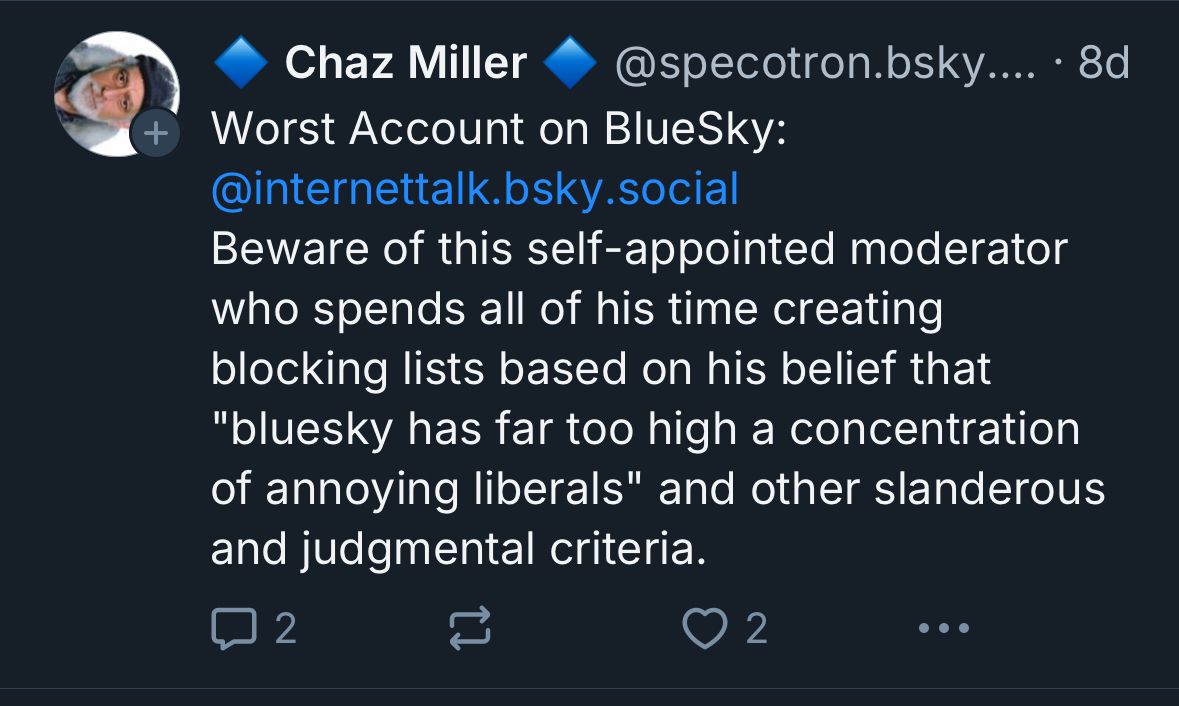
Someone who was really mad at me
*This person was not happy.*
Now, #resist, for all of its faults, is a rather harmless movement. You will annoy some people, but you won't draw serious repercussions. That cannot be said for all of the people you want to create a moderation list for, and you should be aware of that fact.
Lesson #4: rate limits.
Rate limits prevent the number of people you can add to a list, you will likely run into rate limits (you may be able to avoid this if you're using a self-hosted PDS).
The rate limits apply to any action that involves writing to the PDS, so in practice, you become a read-only user for the hour. There are also daily rate limits, and separate rate limits for your IP, so I'd be very careful if you intend to be an active participant on Bluesky, and create a moderation list.
Lesson #5: surprisingly difficult to delete
You would think deletion would be a single shot, quick operation, but it appears to take quite a while, and appears to slowly remove people from the list first. If you don't know all of these lessons first, it might be painful to try and back out of it in the future.
Solution #1: don't do any of this on your main account.
The ideal flow, then, is to create a burner for the purposes of creating semi-private moderation lists, and then subscribe to them on your main account. This should be fairly easy to achieve in practice.
Solution #2: do be aware of what you are subscribing to.
Creating lists on a burner takes away the accountability aspect of creating a list: if you share a list created on a burner, no one can vouch for whether that list is accurate. Even though I have documented my process for creating my list, you have to trust me on the final outcome.